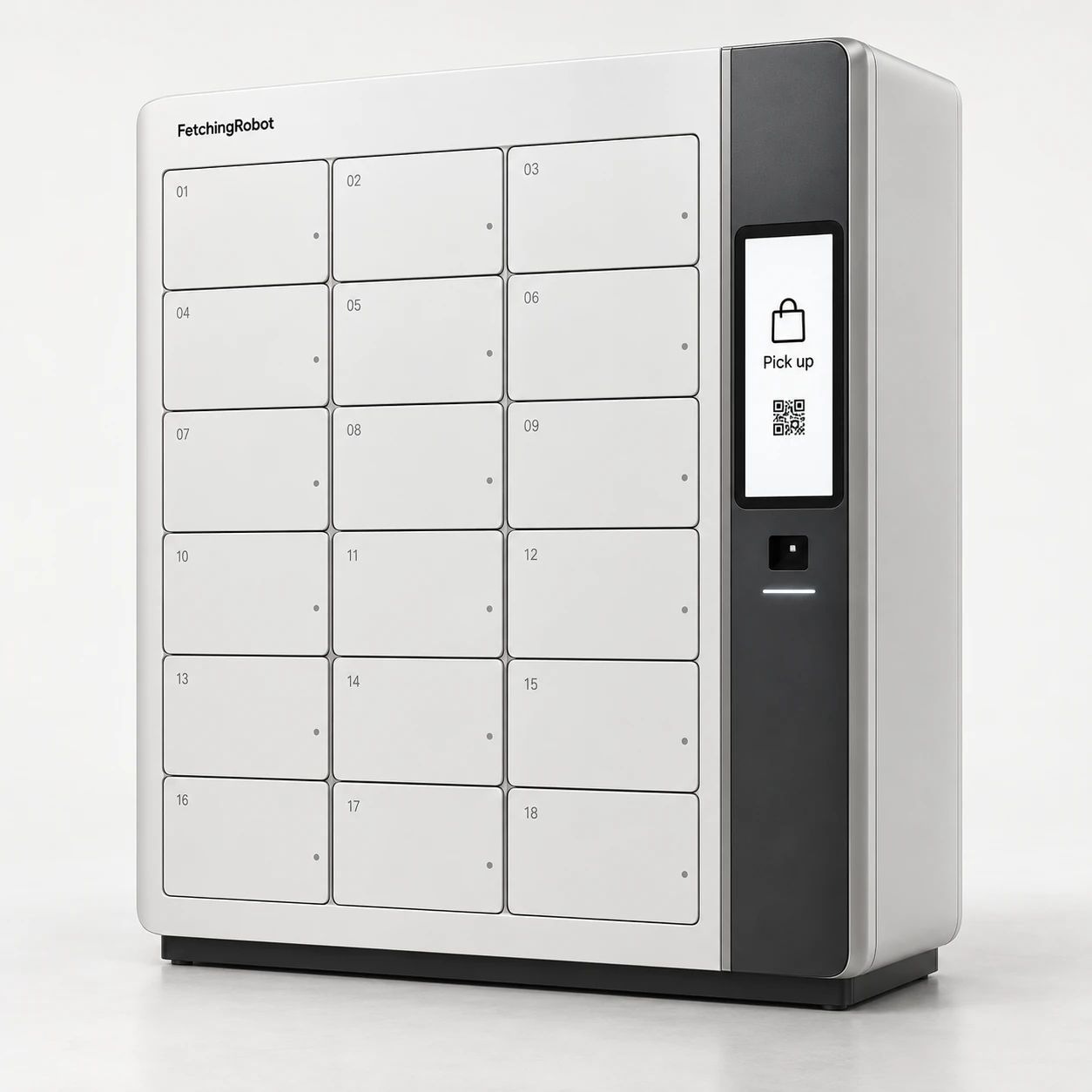
A self-service handoff concept for meals, retail orders and everyday items, bringing drop-off, individual compartment storage, access verification and collection into one workflow. Modular hardware and interfaces can be configured around the site, the items being handled and the operating model for commercial properties, workplaces and residential communities.
Product visualization · Appearance and configuration are subject to project specifications.
Service workflowDrop off · Store · Collect
ConfigurationModular compartments
Deployment planningSite and regional adaptation
DEPLOYMENT SCENARIOS
One handoff concept. Multiple everyday applications.
Plan each installation around the items being handled, service hours and access routes, so drop-off and collection can happen at different times. Compartment sizes, storage conditions and operating procedures are defined for each use case.
01
Retail & click-and-collect
Plan self-service collection for online orders and reserved products once they are ready for pickup at shops, shopping centers and neighborhood retailers, with compartment sizes and capacity matched to packaging and peak demand.
02
Workplaces & campuses
Plan document, office supply and everyday item handoffs across offices, campuses and business parks. Define who can deposit and collect items, with handoff records that support administration and reduce the need to wait for a recipient.
03
Residential & guest services
Plan collection points for everyday goods, parcels and service items in residential communities, hotels and shared spaces, taking delivery routes, resident or guest access and property management into account.
04
Meal delivery & pickup
Organize food collection in offices, campuses and business parks around delivery peaks and packaging sizes. Temperature control, cleaning and holding times are defined specifically for the food service application.
DELIVERY TO COLLECTION
A connected workflow from drop-off to collection.
Handoff tasks and compartment status guide the process. Couriers, retail teams or internal staff can deposit items, with notifications, collection permissions and management systems configured for the project.
01
Create a handoff task
The sender confirms the item or order details at the locker. Compartment selection or assignment considers item dimensions, storage conditions and availability.
02
Deposit & confirm
The sender places the item in the designated compartment, closes the door and confirms the deposit, associating it with a recipient or task reference for collection and operational follow-up.
03
Notify & verify
Collection details are sent through the selected project channel. The recipient verifies access at the locker using a QR code or pickup PIN.
04
Collect & update
Verification opens the corresponding compartment. Collection updates its availability; overdue pickups and door exceptions are referred to staff under the operating procedures.
AI DESIGN DIRECTIONS
Understand handoff activity. Make informed operating decisions.
AI development focuses on drop-off and collection status, exceptions and usage patterns, providing information to support staff review, incident handling and capacity planning.
01
Assisted handoff sensing
Explore sensor and visual information to assess compartment occupancy and item movement, supporting deposit confirmation, collection checks and staff review of exceptions.
02
Overdue & exception alerts
Develop alerts for uncollected items and inconsistent states, with response times defined by item category and operating rules to support staff investigation and follow-up.
03
Usage & turnover analysis
Analyze compartment occupancy, item dwell time and demand peaks to inform compartment layouts, service hours and site capacity planning.
AI applications are optional development directions, with scope, data requirements and validation criteria defined for each project.
REFERENCE CONFIGURATION
Configure around the site, demand and operating model.
The following configurations are planning references. Hardware, software functions and regional adaptations are subject to the project technical specification.
AI Smart Delivery Locker reference configuration
Compartment capacity
12–48 compartments as a modular reference range; sizes, combinations and expansion are selected around item dimensions, weight and peak storage demand.
User interface
10.1-inch touchscreen reference configuration; installation height and interaction design depend on site requirements.
Pickup verification
QR code / pickup PIN interface options, with project-specific order or handoff task association, collection permissions and notifications.
Storage conditions
Short-term ambient storage as the baseline; heated or refrigerated configurations can be assessed for specific applications. Temperature, cleaning, separation and holding-time requirements are defined by item type.
Regional power
115 V AC / 60 Hz or 230 V AC / 50 Hz, with a dedicated power version selected for the destination.
Connectivity
Ethernet, Wi-Fi or cellular options, selected according to site infrastructure, coverage and operational requirements.
Language & localization
Chinese and English interface concepts, with project-specific extensions for languages, time formats, notifications and operating instructions.
Management & optional AI
Management concepts for compartment status, handoff records and exceptions; AI sensing and analytics require a separately defined development and validation scope.
Reference configurations support project planning. Dimensions, power consumption, ingress protection, temperature performance, interfaces and destination requirements follow the project specifications and validation results.
GLOBAL PROJECT PLANNING
Designed around local needs in every market.
Plan equipment and operations together, from installation conditions and business systems to interface languages and regional power requirements.
01
Site & servicing
Confirm installation conditions, circulation, accessible use and maintenance access. Plan compartment separation, cleaning, collection exceptions and outage procedures around the items being handled.
02
Systems & data
Assess connections to retail ordering, delivery management or internal handoff systems. Define task association, notifications, user permissions and data retention, with integration scope subject to API authorization and joint testing.
03
Region & delivery
Confirm destination-specific power, plugs, wireless connectivity and applicable compliance requirements. Define the configuration around local languages, operating procedures and acceptance criteria.
Frequently Asked Questions
Which applications is the AI Smart Delivery Locker intended for?
The concept covers retail order pickup, workplace and campus item handoffs, residential deliveries and meal collection. Define the application around item dimensions and weight, storage conditions, collection permissions, peak demand and servicing needs.
Can different item types share the same locker installation?
Compartment allocation and operating rules depend on the items being handled. Food, retail goods and other items may have different temperature, hygiene, odor and cleaning requirements. Separate zones or dedicated cabinets may be appropriate; the final arrangement is defined for the project.
How are compartment sizes and capacity selected?
Consider the number of items stored simultaneously at peak times, packaging dimensions, weight, typical collection delays and spare capacity. The 12–48-compartment range is a modular planning reference; compartment layouts and load limits must be confirmed for the application.
Can heated or refrigerated storage be specified?
Ambient storage is the baseline. Heated and refrigerated configurations are assessed against the storage needs of the intended items. Temperature ranges, holding times, separation and cleaning procedures depend on the equipment configuration and applicable local requirements.
Can the locker connect to existing business systems?
Connections to retail ordering, delivery management or internal handoff systems can be assessed for each project. Define task association, collection permissions, notifications and exception handling, with scope subject to API authorization, data requirements and integration testing.
How are AI capabilities applied to a project?
Assisted handoff sensing, overdue alerts and usage analysis are optional development directions. Implementation scope is defined by the use case, data conditions, staff review procedures and validation criteria.
What needs to be confirmed for an international deployment?
Confirm the destination, site conditions, item categories, power and connectivity, compartment capacity, interface languages, integration scope and applicable local requirements. The project technical specification defines the configuration and acceptance criteria.